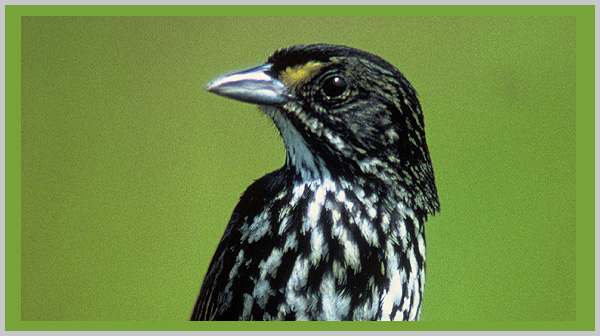
Dusky Seaside Sparrow
Name: Dusky Seaside Sparrow (Ammodramus maritimus nigrescens)
Conservation Status: Extinct
The dusky seaside sparrow became extinct in 1987. It is widely considered to be the most recent, well-documented extinction of a vertebrate in the United States. This black and white seaside sparrow lived on the east coast of Florida and was especially abundant on Merritt Island.
The dusky seaside sparrow depended on moist cordgrass (Spartina bakerii) habitat for nesting sites. Suitable habitat usually is found only at 10-15 feet above sea level. Lower areas are too wet and dense for the sparrow, while higher areas are too dry to support cordgrass.
The decline and disappearance of the dusky seaside sparrow is due entirely to the loss of its habitat. Problems with mosquitoes breeding in the marsh area adjacent to the Kennedy Space Center led to a mosquito control program in 1963 in which the marsh was flooded.
No attempt was made to reduce the harmful effects of the flooding on wildlife that depended on that habitat, such as the dusky seaside sparrow.
Fortunately, another population of dusky seaside sparrows was found in a different marsh and the US Fish and Wildlife Service was persuaded to purchase the area for a reserve. Unfortunately, the reserve did not successfully protect the sparrows.
The Florida Department of Transportation built a highway through the marsh in order to connect the Kennedy Space Center to Disney World. The remaining marsh eventually was drained for real estate development.
The sparrow’s cordgrass habitat could only grow in a very narrow range of moisture conditions. When one habitat area was flooded and the other drained, there was nowhere for the seaside sparrow to live. In the mid-1970s, an effort was made to restore natural water flow in one of the areas. While native vegetation did gradually return, it was too late for the sparrow.
In 1979 and 1980, a captive breeding program was established. However, only seven dusky seaside sparrows were located and they were all male. Because there were no females left to help reproduce the species, the captive breeding program brought in females from a closely related subspecies of sparrow.
Cross-breeding attempts, such as this, are designed to preserve some of the genetic diversity represented by a species. The female offspring of the cross-bred pair could then breed with the other male seaside sparrows.
Through this kind of breeding, an individual with a very high percentage of seaside sparrow genes (although not 100%) could live to carry on much of the genetic diversity that would otherwise be lost. Unfortunately, the cross-breeding attempts were unsuccessful. The last dusky seaside sparrow died in captivity in 1987.
Questions for Thought:
Why was the dusky seaside sparrow not saved by the Endangered Species Act? Even if the cross-breeding had been successful, could we really say that the seaside sparrow had been saved?
If the seaside sparrow had not had such specialized habitat needs, it would not have become extinct. What does this indicate about other animals which can live only in a type of habitat that is not common?
Related Classroom Activities:
[CS2-8,C3-1,C3-2, General]